Service Overview
Rebuilding Coastlines Across the Gulf Coast
Louisiana loses approximately one football field of coastline every 100 minutes. U.S. Aqua is on the front lines of that fight - performing large-scale marsh creation, ridge restoration, and shoreline stabilization for the agencies and organizations working to reverse decades of coastal land loss.
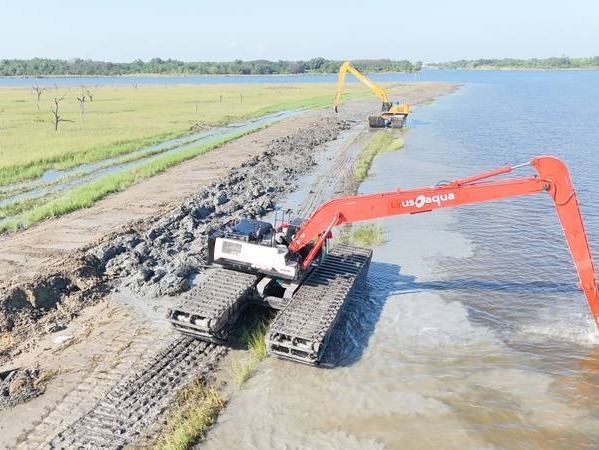
We self-perform beneficial use of dredged material projects, pumping sediment through miles of discharge pipeline to rebuild eroded wetlands. Our amphibious excavators operate in the soft soils and shallow waters where conventional equipment can't reach, placing material with precision to create new marsh habitat and restore protective ridges.
From multi-million dollar CPRA contracts to conservation projects with Ducks Unlimited, our crews and equipment are purpose-built for the unique challenges of coastal restoration work.
How We Work
From Assessment to Restored Habitat
01
Site Assessment
We evaluate sediment sources, placement areas, access routes, and environmental conditions to develop a restoration plan that meets agency specifications.
02
Mobilization
Amphibious excavators, dredge pumps, discharge pipelines, and support vessels are transported by barge to the project site and staged for operations.
03
Sediment Placement
Dredged material is pumped or mechanically placed to rebuild ridges, create marsh platforms, and stabilize shorelines per the restoration design template.
04
Grading & Closeout
Final grading ensures proper elevations for marsh vegetation growth. Post-construction surveys confirm volumes and compliance with contract specifications.
Related Industries
Industries That Depend on Marsh Restoration
Oil & Gas
Pipeline corridors through coastal marshes require restoration after construction. Healthy wetlands also protect energy infrastructure from storm surge damage.
Commercial Fishing & Aquaculture
Gulf Coast marshes serve as nursery habitat for shrimp, crab, oysters, and fin fish. Marsh loss directly reduces commercial harvest yields across the region.
Flood Protection & Infrastructure
Coastal wetlands absorb storm surge - every 2.7 miles of marsh reduces surge height by one foot. Restoration is critical for protecting levees, roads, and communities.
Shipping & Port Operations
Dredged material from navigation channel maintenance can be beneficially used to restore adjacent marshes rather than disposed of in open water.
Wildlife & Conservation
Migratory bird flyways, waterfowl nesting habitat, and endangered species depend on healthy Gulf Coast wetlands that are disappearing without restoration.
Coastal Development & Real Estate
Waterfront property values, tourism revenue, and recreational fishing economies all depend on the health and stability of surrounding marsh ecosystems.
Frequently Asked Questions
Marsh Restoration FAQ
-
What is marsh restoration and why is it important?
Marsh restoration is the process of rebuilding eroded or degraded coastal wetlands using dredged sediment, vegetation planting, and shoreline stabilization techniques. It is critical for flood protection, storm surge reduction, habitat preservation, and maintaining the ecological health of coastal Louisiana and Gulf Coast communities. Louisiana alone loses approximately one football field of coastline every 100 minutes. For more context, see our article on the importance of dredging.
-
What is beneficial use of dredged material?
Beneficial use is the practice of repurposing sediment removed during dredging operations to restore marshes, nourish beaches, create habitat, or build flood protection features rather than disposing of it in open water. U.S. Aqua performs beneficial use projects for CPRA, USACE, and conservation organizations, pumping dredged material through pipelines to designated restoration sites. Learn more in our guide to beneficial uses of dredged material.
-
What types of marsh restoration does U.S. Aqua perform?
U.S. Aqua performs ridge restoration, marsh creation using beneficial use of dredged material, shoreline stabilization with rock and sediment placement, wetland terracing, and habitat restoration for bird nesting colonies. Projects range from small conservation efforts with Ducks Unlimited to multi-million dollar CPRA coastal restoration contracts.
-
What equipment is used for marsh restoration?
Marsh restoration requires amphibious excavators (marsh buggies) with low-ground-pressure tracks, long-reach excavators on spud barges, hydraulic dredge pumps for sediment transport, HDPE discharge pipelines, and support vessels. U.S. Aqua owns and maintains its own fleet of amphibious and dredging equipment specifically designed for soft-soil wetland environments. Read about the 9 different applications of marsh excavators to see how this equipment is used.
-
Where does U.S. Aqua perform marsh restoration work?
U.S. Aqua performs marsh restoration primarily across coastal Louisiana, including Bayou La Loutre, the Barataria Basin, and Gulf Coast barrier islands. Projects also extend to Alabama, South Carolina, Texas, and other Gulf and Atlantic coast states where wetland loss and coastal erosion require intervention.


