
9 min read
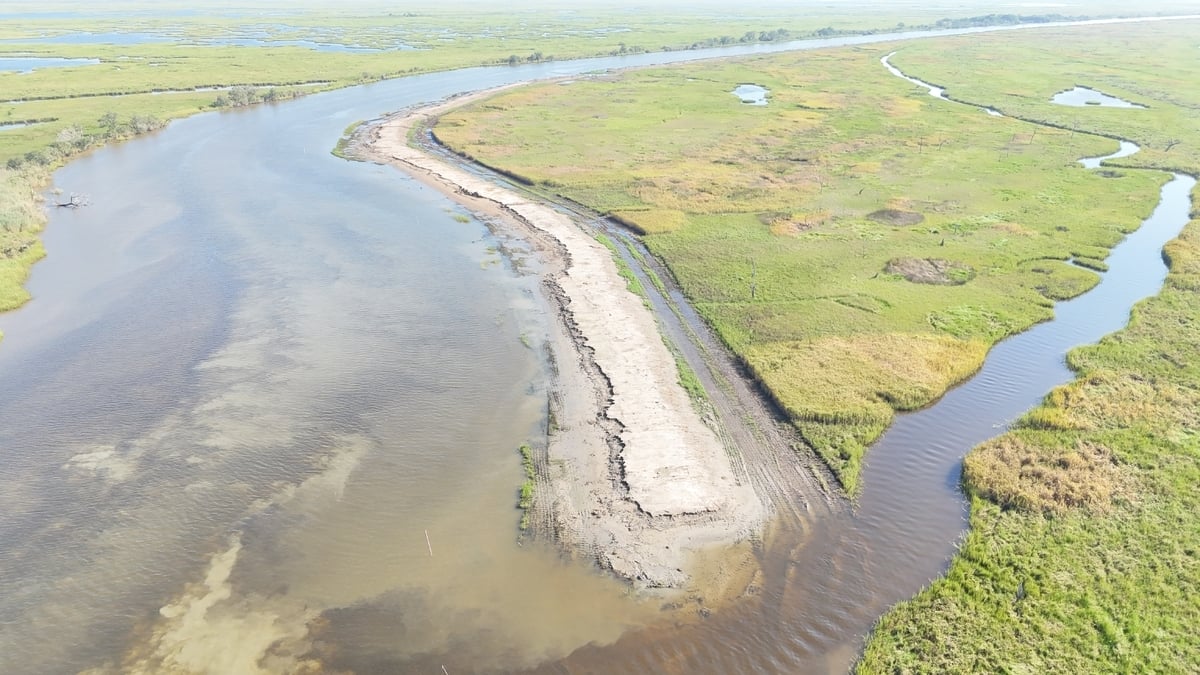
If your pipeline access, channel or levee permit requires beneficial use of dredged material, plan the marsh creation cell before you dredge, not after. Pick a placement site close to the cut, build containment first, and fill to a target elevation that accounts for settling. Running the access work and the habitat work in one mobilization with amphibious equipment is usually the simplest way to meet the requirement without a separate haul or a second crew.
In this post:
- What Is Beneficial Use of Dredged Material?
- Why Are Permits Requiring Beneficial Use More Often?
- When Is Beneficial Use Required?
- Marsh Creation vs. Other Ways to Meet Beneficial Use Requirements
- How Does Dredged Sediment Become Marsh?
- How Do You Combine Access Work and Marsh Creation in One Mobilization?
- What Equipment Does Marsh Excavation Take?
- Key Takeaways for Permit-Driven Marsh Creation

Marsh creation is what happens when the mud from your project stops being a disposal problem and becomes new wetland. Louisiana's coastal parishes lost about 2,006 square miles of land between 1932 and 2016, according to the USGS, so regulators now treat dredged sediment as something to keep in the system. That's why more pipeline, channel and levee permits come with a beneficial use condition attached. Here's what triggers those conditions, how sediment turns into marsh, and how to fold the habitat work into the job you were already doing.
What Is Beneficial Use of Dredged Material?
Beneficial use of dredged material is the practice of putting sediment removed during dredging to a productive purpose - building wetlands, nourishing beaches, raising land - instead of dumping it. The U.S. Army Corps of Engineers defines it broadly in its beneficial use program guidance, covering fish and wildlife habitat, recreation, and industrial or commercial uses.
Beneficial use of dredged material (often shortened to BUDM) is the umbrella term regulators use. Marsh creation is one type of BUDM where dredged sediment is pumped or placed into shallow open water or broken-up wetland until the surface reaches an elevation where marsh grasses can grow.
From the contractor's side, the permit rarely says "build a marsh." It says something like "use dredged material beneficially" or asks for a beneficial use plan. In coastal Louisiana, marsh creation is usually the most practical way to satisfy that language. The material is already wet and fine-grained, open water is close by, and the state's coastal program is built around rebuilding lost marsh.
Key takeaway: Beneficial use is the requirement. Marsh creation is one of the most common ways to meet it on coastal access, channel and levee jobs.
Why Are Permits Requiring Beneficial Use More Often?
Permits require beneficial use more often because federal and state agencies now treat dredged sediment as a resource to keep in the coastal system, not waste to get rid of.
At the federal level, the Chief of Engineers set a goal for the Corps to use 70% of its dredged material beneficially by 2030, according to the USACE Beneficial Use program. That's a big jump. Dredging Today reports that more than 200 million cubic yards are dredged from federal navigation channels every year, and only about 30-35% of the usable material currently goes to beneficial use.
Congress has pushed in the same direction. The Water Resources Development Acts of 2016 and 2020 directed the Corps to expand beneficial use, and WRDA 2020 set a national policy to maximize it on Corps projects.
Louisiana has the strongest reason of any state to care. The USGS found that from 1985 to 2010, the coast lost wetland at a pace equal to roughly one football field per hour. Louisiana also accounts for the large majority of coastal wetland loss in the lower 48, as Wikipedia's summary of Louisiana coastal erosion lays out with sources.
At that pace, sidecasting spoil into open water looks like throwing sediment away, so reviewers ask contractors to put it back to work.
When Is Beneficial Use Required?
In Louisiana's coastal zone, beneficial use rules apply to any project that needs a state coastal use permit and dredges 25,000 cubic yards or more to allow vessels to move or moor. That threshold comes from the Louisiana Office of Coastal Management, which tightened its rules after finding that only about 22% of roughly 3 million cubic yards dredged each year under the old program was actually used beneficially.
A BUDM plan is the document attached to the permit application that spells out how the dredged material will be used, as defined in the Louisiana Administrative Code.
Federally, the Corps reviews dredge-and-fill work under Section 404 of the Clean Water Act, and those permits can add their own placement conditions.
Here's how it looks on typical jobs.
| Project type | Permits usually involved | How beneficial use typically shows up |
|---|---|---|
| Pipeline access or flotation canal | A state coastal use permit and a federal Section 404 permit are commonly both needed in the Louisiana coastal zone. | Permit conditions may require the excavated material to be placed to restore or create wetland instead of being left as a spoil bank. |
| Navigation channel, slip or mooring basin | A coastal use permit is required, and the 25,000 cubic yard vessel-access threshold often applies. | The applicant has to submit a BUDM plan, and marsh creation next to the channel is a common way to satisfy it. |
| Levee construction or levee lift | Levee work usually needs coastal and federal approvals, plus coordination on borrow areas. | Material dug from borrow areas or canals can be routed into adjacent marsh cells so the project adds habitat while it adds protection. |
| Corps maintenance dredging | The Corps operates under the federal standard and its 70% by 2030 beneficial use goal. | Maintenance material is increasingly pumped into marsh creation or nourishment sites instead of open-water disposal. |
Marsh Creation vs. Other Ways to Meet Beneficial Use Requirements
Marsh creation is one of four ways Louisiana permit holders can satisfy beneficial use, and it's the option that keeps the work, and the result, on your own project. The state's rules, described by the Louisiana Office of Coastal Management, give applicants flexibility when site conditions get in the way.
| Option | What it means | When contractors tend to choose it |
|---|---|---|
| Direct beneficial use on your project | You use the dredged material yourself to build, restore or protect wetlands, which usually means marsh creation next to the cut. | This works best when open water or degraded marsh sits close to the dredge site and the sediment is clean enough to place. |
| Place material on an approved restoration project | Your dredged material goes to an existing state-approved coastal restoration project instead of a site you design. | This fits when a restoration project is already underway nearby and can accept your material on your schedule. |
| Alternative site with equal benefit | You dredge material from a different location to create the same amount of wetland benefit. | This makes sense when your own material is unsuitable but suitable sediment is available somewhere practical. |
| Contribution to the Coastal Resources Trust Fund | You pay an in-lieu amount based on the volume dredged instead of placing material. | Applicants usually fall back on this when distance, logistics or sediment quality make direct placement unworkable. |
From a contractor's view, the first option often wins on control. You already have equipment and crews on site. Adding a containment cell and a short discharge line can turn a permit condition into a visible habitat gain that the owner can point to.
How Does Dredged Sediment Become Marsh?
Dredged sediment becomes marsh through five steps: containment, placement, settling, reaching target elevation, and vegetation. Each step depends on the one before it, and the most common failures come from skipping containment or underestimating how much the material will settle.
Build Containment First
Containment means building low earthen dikes around the fill area so the sediment stays where you put it. Marsh excavators usually build these dikes from material on site. Weirs or spill boxes let excess water drain out while the solids stay behind.
Place the Sediment
Placement is either hydraulic or mechanical. Hydraulic placement uses a dredge to pump a sediment-and-water slurry through pipeline into the cell. Mechanical placement uses excavators to move material directly, which works for smaller volumes or tight access canals.
Let It Settle and Dewater
Fine-grained sediment goes in loose and full of water. Over the following months it consolidates and drops. Crews plan for that by filling above the final target so the surface lands in the right range after it settles.
Hit the Target Elevation
Target elevation is the surface height where local marsh plants grow best - high enough to stay out of permanent standing water, low enough to flood with the tides. Getting this right is the difference between a marsh and a mudflat or upland. Surveys before, during and after filling keep it honest.
Let Vegetation Take Hold
Once the surface is at grade, marsh grasses either colonize naturally or get planted. Containment dikes are often gapped later to restore tidal exchange, which brings in seeds, nutrients and fish.
How Do You Combine Access Work and Marsh Creation in One Mobilization?
You combine them by staging the marsh creation cell next to the access route and using the same amphibious crew and equipment to do both the cut and the fill. The dredged material comes out of the canal and goes straight into a contained cell instead of being sidecast or barged away.
On a typical pipeline access job, a marsh buggy excavator (an excavator mounted on pontoon tracks that floats and crawls through soft marsh) digs the flotation canal. Before it starts, the same machine builds the containment dikes for the cell. For larger volumes, a small cutter suction dredge pumps material into the cell through floating pipe, which our guide to types of dredgers covers in more detail.
Doing it this way has real advantages:
- One mobilization and demobilization instead of separate crews for access and restoration.
- Short discharge distances, because the placement cell sits next to the cut.
- No barge haul or offsite disposal for the excavated material.
- One permit story that shows regulators exactly where every cubic yard goes.
- A visible habitat result the owner can report, rather than a trust fund payment.
The planning has to happen early. The cell location, dike alignment and target elevation should be in the BUDM plan before the permit is issued, not figured out once the canal is half dug. If you're working through that planning now, our marsh restoration services team can help line up equipment around the permit.
What Equipment Does Marsh Excavation Take?
Marsh excavation and wetland construction take amphibious, low-ground-pressure equipment that can work in water, mud and soft marsh without sinking or tearing up the surface. The same fleet usually handles both the access work and the marsh creation.
| Equipment | Role in access work | Role in marsh creation |
|---|---|---|
| Marsh buggy (amphibious excavator) | It digs flotation and access canals in soft ground where conventional excavators would bog down. | It builds containment dikes, shapes the cell and moves material mechanically on smaller fills. |
| Cutter suction dredge | It cuts and pumps material from canals and channels that are too long or deep to excavate efficiently. | It delivers slurry through pipeline into the placement cell, which suits larger volumes. |
| Booster pump and floating pipeline | It extends how far a dredge can pump when the discharge site is farther from the cut. | It lets crews reach the best placement site instead of settling for the closest one. |
| Swamp buggy or tracked carrier | It moves crews, fuel and supplies across marsh without building roads. | It supports surveying, planting and monitoring crews after the fill is placed. |
If you need the fleet more than the full crew, U.S. Aqua's dredging equipment is available for rental. For projects on sandier shorelines, our post on beach reclamation and sand dredging covers how that side of beneficial use works.
Key Takeaways for Permit-Driven Marsh Creation
Marsh creation turns a beneficial use requirement from a cost line into a habitat result, as long as it's planned before the first bucket of material comes out. Here's what to keep in mind:
- Check the threshold early. In Louisiana's coastal zone, dredging 25,000 cubic yards or more for vessel access triggers beneficial use rules.
- Write the marsh into the BUDM plan. Regulators want to see cell location, containment and target elevation up front.
- Contain before you place. Dikes and weirs keep sediment where it belongs.
- Overfill for settling. Fine material drops as it dewaters, so build above final grade.
- Use one crew and one fleet. Amphibious equipment can handle the cut and the fill in a single mobilization.
The Louisiana Coastal Protection and Restoration Authority builds marsh creation into its long-range coastal plan. Permit-driven projects add to that effort one access canal at a time.

About U.S. Aqua Services
U.S. Aqua Services was created to support the dredging process in advancing commerce and responding to its many challenges. To accomplish this, our dredging company assembled an exceptional group of experienced individuals and a diverse inventory of dredge equipment.
We offer dredging equipment rental services so you can have access to the latest and greatest in dredging technology without having to pay to maintain it, transport, and store it, along with dewatering services.
With an emphasis on mobility, dependability, durability, diversity, efficiency, and safety, our dredging rental company can ensure that our different types of dredging systems are easy to move through any terrain and can work in the most rugged and remote environments. Our multi-function hydraulic systems are built with jetting and mechanical options that can efficiently move loose sediment or stiff layers of clay.
US Aqua services also and maintains a ready fleet of amphibious equipment capable of completing dredging projects in some of the harshest and most remote environments. U.S Aqua is also the dealer for Louisiana of the amphibious vehicle Fat Truck. No matter the size or scope of the job or the remoteness of your work location, you can rely on Fat Truck’s industrial off-road utility vehicles to get the job done right.


